-
-
-
At the recent AABC Europe I sat in on the highly insightful talk by Edwin Knobbe from BMW on the coupling of electrochemistry and mechanics inside battery cells. Two slides stood out.
-
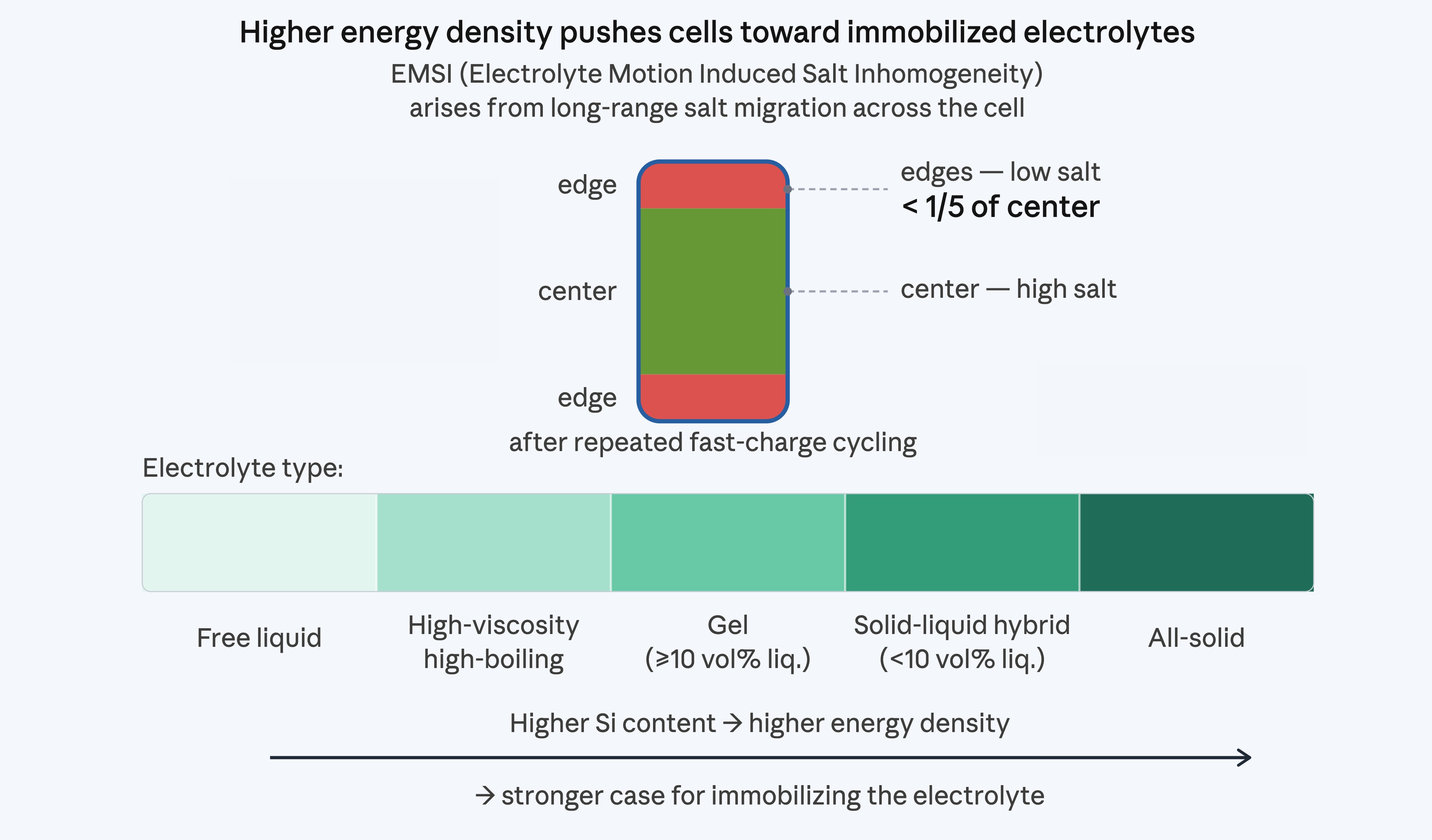
The first: LiPF6 concentration at the edges of the jelly roll dropping below 1/5 of the value in the center – built up over repeated fast-charge cycling.
-
The second: teardown photos of cells that had plated metallic lithium on the edge of negative electrodes after repeated fast charging, while the slow-charged references stayed clean.
-
Overcome that plating, and a real barrier towards ≈5-minute fast charging in high-energy cells falls away.
-
The mechanism behind it – Electrolyte Motion Induced Salt Inhomogeneity (EMSI), described by Sophie Solchenbach and co-workers, highlighted by Jeff Dahn at the International Battery Seminar & Exhibit 2025 – translates into the challenge of hitting a narrow electrolyte-fill "sweet spot."
-
More background on EMSI: an earlier, extended write-up on BatteryDesign.net.
-
With the additional data laid out at AABC, a more general reading becomes clearer: EMSI is fundamentally a long-range transport problem. The electrochemistry only needs ion transport over ≈100 µm – but the displaced electrolyte travels centimeters, to the edges and the void spaces, and that is where salt piles up or runs low.
-
As cells push silicon content for energy density, the driving force for this long-range migration only grows – more swelling, leaner electrolyte, larger formats.
-
The safe window for a freely mobile liquid narrows. The effect can be expected to bite earliest where fast charge and high Si collide.
-
High-energy designs will likely respond in different ways – some by immobilizing the electrolyte (gel → solid-liquid hybrid → all-solid), others by engineering the liquid and the fill window hard enough to live with it.
-
There's another reason this matters, beyond cycle life. For programs moving toward immobilized electrolytes, there's an under-appreciated upside: a root cause you design out doesn't have to be managed for the life of a program, validated cell by cell, or simulated at full cell dimensions.
-
A potential objection sits underneath this: higher viscosity has always meant lower conductivity, and therefore worse fast charge – which is exactly why electrolytes were optimized near the conductivity peak. But that holds only at the ≈100 µm scale. EMSI adds a second, long-range cost to a freely mobile liquid, and the depleted edge it creates is itself a low-conductivity zone.
-
So the question shifts from "what maximizes bulk conductivity?" to "what keeps conductivity up where the cell actually plates?" Those used to be the same answer. They may no longer be.
-
This post was also published on LinkedIn.
|