-
-
At last week's Solid-State Battery Summit in Chicago, one point came through with unusual consistency across talks: major progress has been made towards operating all-solid / solid-liquid electrolyte Li-ion batteries without excess stack pressure – or at most ≈1 MPa.
-
For some time, it was genuinely unclear where the value chain would settle. If multi-MPa operation had remained the price of admission, a whole layer of value would have shifted towards pack engineering – precision fixtures, compliant tensioning hardware, pressure management as a permanent cost center, carried in every pack shipped.
-
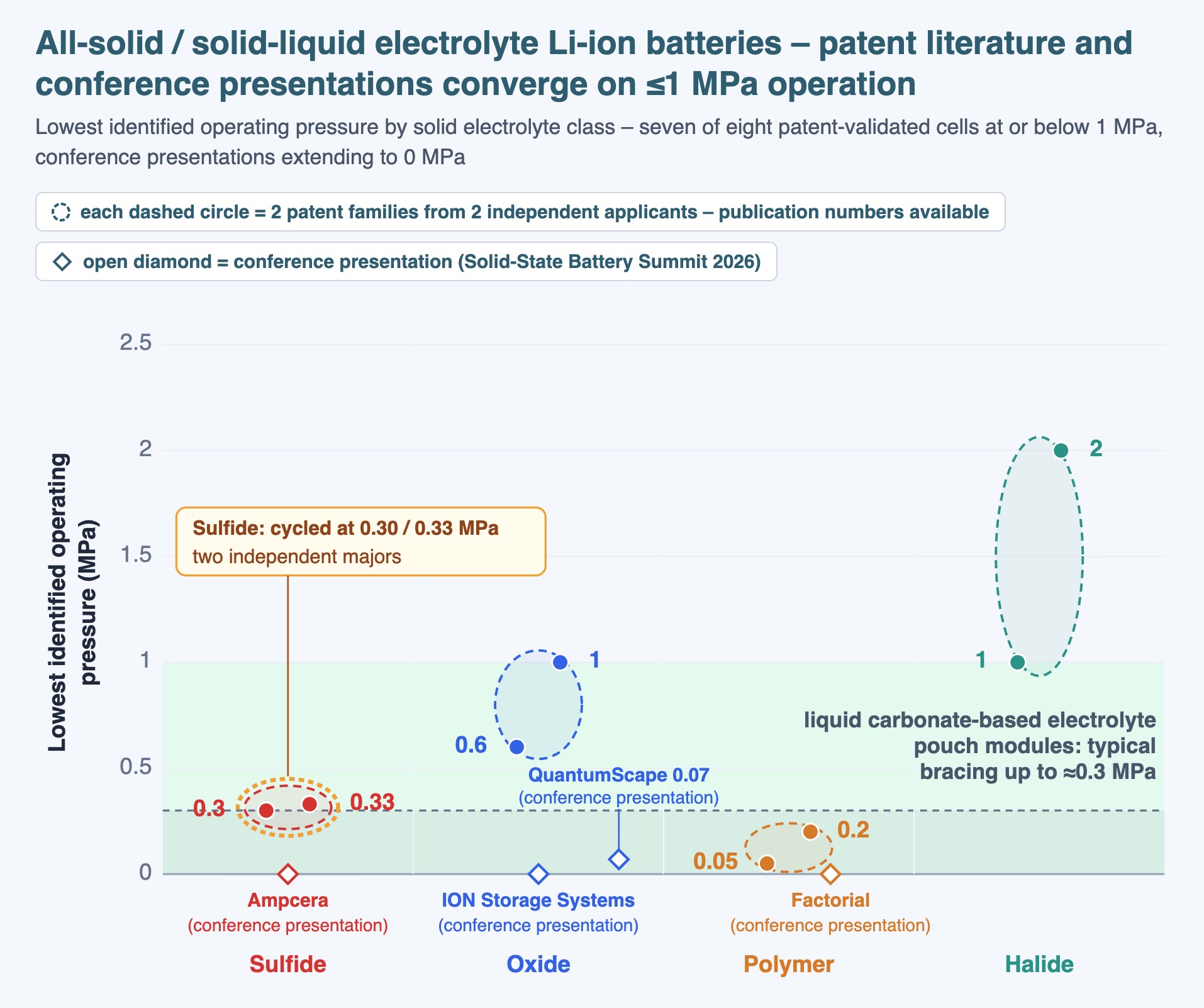
What the conference talks (including by Ampcera, Factorial, ION Storage Systems, QuantumScape) confirmed, the patent literature had already been signaling directionally (see chart, AI-based patent analysis by b-science.net).
-
Every class (when used at ≥50% of overall electrolyte volume) – sulfide, oxide, polymer, halide – now carries low-pressure cell data, reached through interface-forming additives, softening phases, elastomeric networks and engineered interlayers. Notably, sulfide-based cells have been made tolerant to lower pressure – via approaches such as molecular-crystal additives and self-healing elastomeric networks – and cycled at 0.30 / 0.33 MPa by two independent majors according to the patent literature (2025–26).
-
There is a subtlety in what those softening components typically are. They sit somewhere along a polymer → oligomer → plasticizer → high-boiling solvent gradient – and how close to all-solid different chemistries will end up along that gradient is difficult to predict.
-
What generally does hold across the gradient is the safety direction: these components are far less volatile than liquid carbonate electrolytes (boiling points of >200 °C instead of <130 °C for typical linear carbonates). Even designs that stop short of all-solid tend to retain an inherent safety advantage.
-
The expectations placed on those materials are high, because pressure was doing real work. Under multi-MPa loads, both Li-metal and Si-based negative electrodes can be forced into adopting comparably dense structures upon cycling.
-
At ≤1 MPa, lithiation uniformity and the avoidance of crack formation have to be controlled by careful material, electrode and cell design.
-
Much of the low-pressure evidence is still sub-scale, and the failure mode without external force – void formation and gradual contact loss – tends to reveal itself late. What would settle it: multi-layer pouch operation at ≤1 MPa over automotive cycle life, with the same retention at automotive format as in small cells.
-
This post was also published on LinkedIn.
|