b-science.net
FAQ ☰ Use Cases Blog About Us Register Log In


2026-10-27
Patent Analysis Switch to Visual Summary

Triweekly Patent Update – Free Version

Lithium-ion batteries – electrolytes – all-solid & solid-liquid

TOYOTA MOTOR CO LTD [JP] / CN 122843729 A

ALL-SOLID-STATE BATTERIES

A sulfide all-solid-state battery stack suppresses short circuits between adjacent electrode bodies caused by stacking misalignment, using an insulating spacer on the negative current collector foil of alternate electrode bodies.

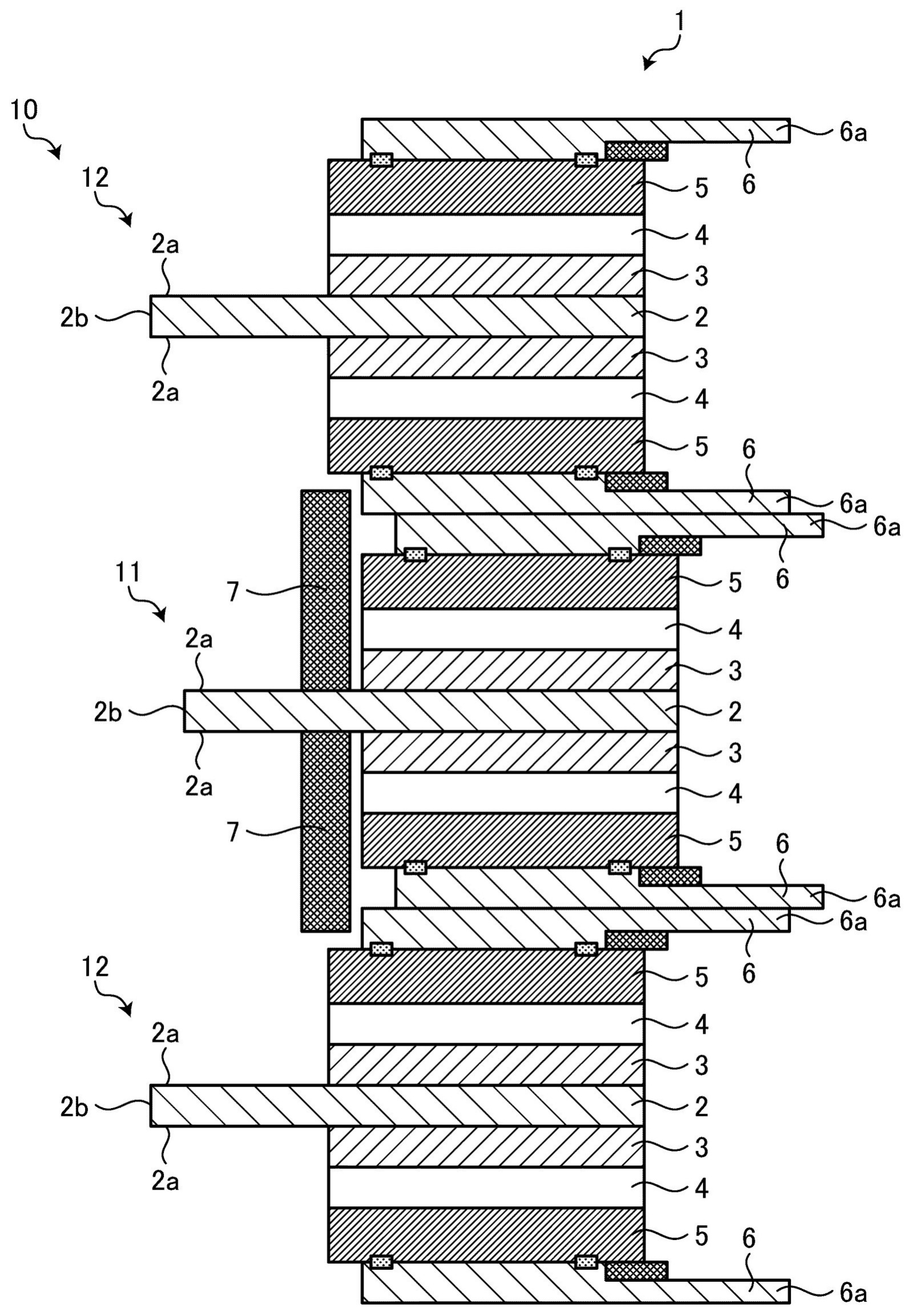
Each electrode body carries, on both faces of a central negative current collector foil, a negative mixture layer, solid electrolyte layer, positive mixture layer and positive current collector foil. Spacer-free bodies occupy both outer stack positions. On the negative tab side, the spacer fills the stacking-direction gap between its own negative foil and the neighboring body's positive mixture layer. Its thickness lies between the summed negative mixture, solid electrolyte, positive mixture and positive foil thicknesses and that sum plus one further positive foil thickness.

First, a lithium titanate (LTO), sulfide solid electrolyte and PVdF mixture was coated onto both faces of Al foil, and a solid electrolyte layer (sulfide, butadiene rubber) and a positive mixture (LiNbO3-coated LiNi1/3Co1/3Mn1/3O2, Li2S–P2S5 glass ceramic) were coated onto Al transfer foils. Second, both layers were transferred onto each face of the negative layer by roll pressing (0.4 t/cm). Third, the three-layer electrode was densified (165°C, 5 t/cm) to 150 μm (negative foil 15 μm), and polyimide tape (80 μm) was applied to both negative foil faces. Fourth, carbon-coated Al foils were bonded to both positive layers, and the stacked bodies were vacuum-sealed in laminate film. No electrochemical or short-circuit test data was identified.

11: electrode body with spacer
12: electrode body without spacer
2: negative current collector foil (Al)
2a: negative current collector foil surface
2b: negative tab
3: negative electrode mixture layer (LTO)
4: solid electrolyte layer (sulfide)
5: positive electrode mixture layer (LiNbO3-coated NCM)
6: positive current collector foil (Al with carbon layer)
6a: positive tab
7: spacer (polyimide tape)

Figure: Schematic of the electrode body stack, showing electrode bodies with and without the polyimide tape spacer on the negative current collector foil.
TOYOTA MOTOR CO LTD [JP] / Patent Image
Takeaway: Concentrating the insulation in a thickness-matched spacer on alternate electrode bodies, rather than insulating within each body, targets the inter-body short circuits that stacking offset creates in multi-body all-solid-state stacks. Because the spacer is a tape applied after densification, it adds a single step compatible with sheet-based stacking.

Lithium-ion batteries – negative electrode (excluding Li metal electrodes)

SHANGHAI SHANSHAN NEW MATERIAL CO LTD [CN] / CN 122809475 A

A SILICON-CARBON ANODE MATERIAL AND ITS PREPARATION METHOD, AND A LITHIUM-ION BATTERY

An aluminum oxide interlayer formed by atomic layer deposition (ALD) separates the porous carbon scaffold of a silicon-carbon anode material from the subsequently deposited silicon. The scaffold, made from coconut shell by carbonization and steam activation (only temperature ranges given), exhibits a total pore volume of 0.8 cm3/g with 90% micropores.

At 100°C and 1.33 kPa, aluminum chloride (AlCl3) was pulsed onto the scaffold for 100 s in N2 carrier gas (30 sccm), followed by a 60 s N2 purge, for 10 ALD cycles. The layer was then oxidized in hydrogen peroxide (H2O2, 10 mol/L, 60 min) to Al2O3.

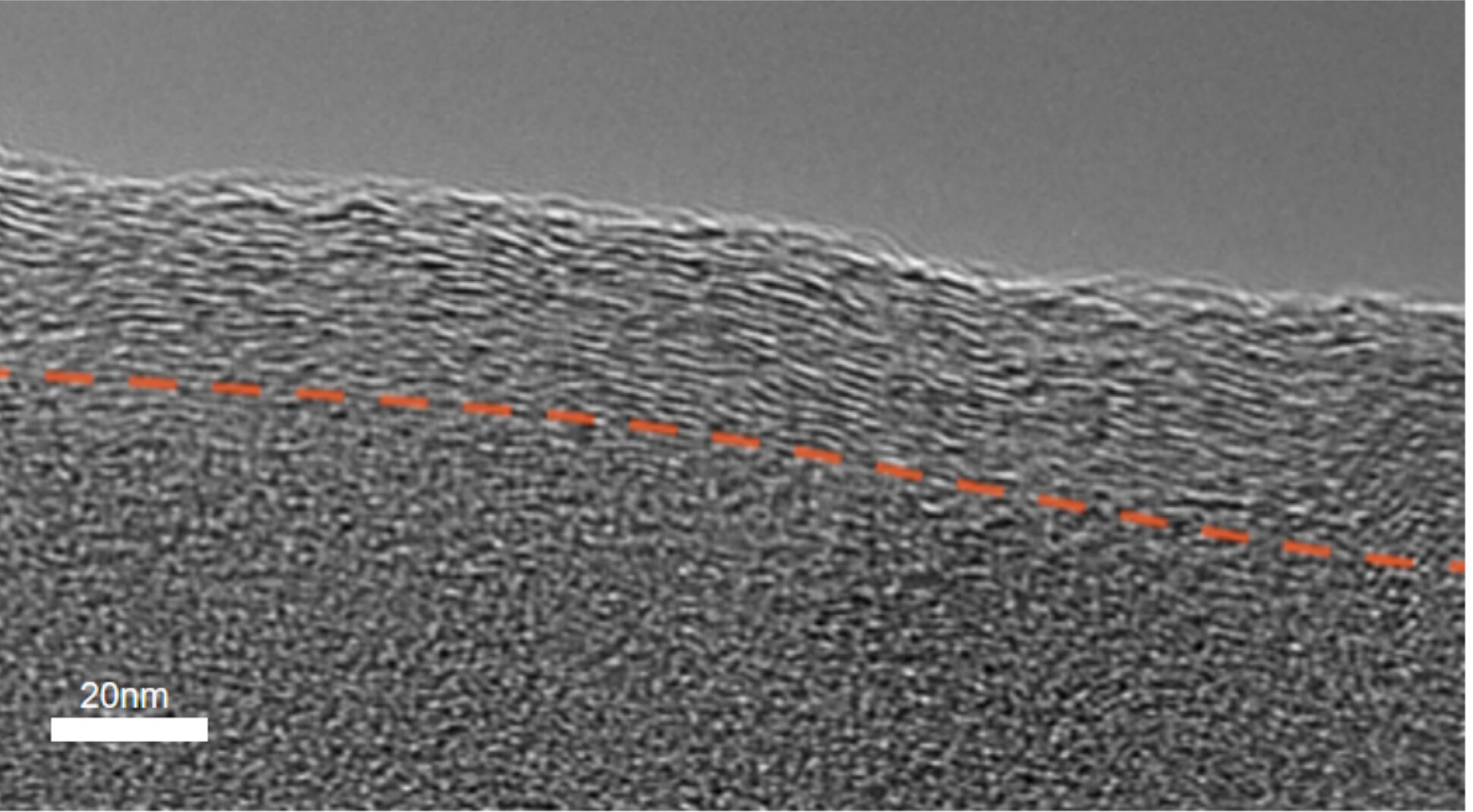
Silicon was deposited from monosilane (SiH4, 10 L/min) under N2 (40 L/min) at 550°C for 6.5 h in a fluidized bed, followed by carbon coating from acetylene (5 L/min) at 700°C for 4 h. The material exhibits a 5 nm Al2O3 interlayer (TEM), 49.70 mass% Si, and amorphous silicon (XRD).

In half-cells against lithium metal (0.01–1.5 V, 0.1 A/g), the material exhibits a first charge capacity of 1,754.4 mAh/g and a first cycle efficiency of 90.7%, as compared to 503.4 mAh/g / 70.2% for an uncoated scaffold, whose XRD exhibits pronounced SiC peaks, and 1,554.4 mAh/g / 85.7% for Al2O3 formed by liquid-phase aluminum nitrate impregnation instead of ALD. It further exhibits a powder resistivity of 3.6 Ω·cm (20 MPa) and a 4 C discharge capacity retention of 50%, as compared to 40.3 Ω·cm / 31.3% for the liquid-phase variant, as well as a capacity retention of 91% after 400 cycles (1 A/g) and an electrode expansion of 120% in the lithiated state after 1.5 cycles.

Figure: TEM image of the Al2O3-coated porous carbon after 20 ALD cycles (Example 3), with the layer above the dashed line assigned by the patent to the ≈15 nm interlayer (scale bar: 20 nm).

SHANGHAI SHANSHAN NEW MATERIAL CO LTD [CN] / Patent Image
Takeaway: An ALD-derived Al2O3 interlayer between porous carbon and deposited silicon suppresses the silicon–carbon reaction to SiC during carbon coating at elevated temperature, preserving amorphous silicon with its isotropic volume change. Vapor-phase growth is presumed to avoid the pore blocking the patent attributes to liquid-phase impregnation, which shifts silicon onto outer particle surfaces. The benefit is measured against an uncoated scaffold coated at the same temperature, not against the low-temperature acetylene coating the patent describes as common practice, so the net gain over current processes remains unquantified.

Lithium-ion batteries – positive electrode

LG ENERGY SOLUTION LTD [KR] / WO 2026212180 A1

POSITIVE ELECTRODE ACTIVE MATERIAL AND LITHIUM SECONDARY BATTERY COMPRISING SAME

Li2CO3, MnO, Mn2O3, and TiO2 were ball-milled in stoichiometric ratio under Ar (bimodal zirconia balls, 350 rpm, 12 cycles of 1 h), heat-treated in Ar (600°C for 3 h, then 900°C for 12 h), and ball-milled with carbon black (10 mass%, 350 rpm, 1 h) to form a carbon coating.

The resulting Li1.2(Mn2+)0.029(Mn3+)0.371(Ti4+)0.399O2 is a lithium-excess lithium manganese titanium oxide (LMTO) with a disordered rock-salt (DRX) structure, in which lithium and transition-metal ions randomly share cation sites and capacity arises from both transition-metal and oxygen redox. Mn and Ti (Mn2+ 3.6, Mn3+ 46.4, Ti4+ 49.9 mol%) are the only transition metals. The patent attributes the role of the coating to improved electronic conductivity.

In half-cells with a lithium-metal negative electrode (0.1 C, 2.0–4.65 V vs. Li+/Li, 45°C), the material exhibits an initial discharge capacity of 276 mAh/g, as compared to 249 mAh/g for 10 mass% carbon-coated LMTO in which Nb5+ replaces part of the Mn and Ti, 237 mAh/g for Mn3+/Ti4+ LMTO with a carbon coating below the range (6.259 mass%), and 21.4 mAh/g for uncoated Mn3+/Ti4+ LMTO.

Takeaway: Limiting a lithium-excess disordered rock-salt Mn–Ti oxide to Mn2+/Mn3+ and Ti4+ as the only transition-metal ions, combined with a carbon coating of at least 8 mass%, raises its 45°C discharge capacity. Lower carbon contents or added Nb5+ reduce capacity.

Fuel cells (PEMFC / SOFC / PAFC / AEMFC) – electrochemically active materials

TOYOTA CHUO KENKYUSHO KK [JP] / TOYOTA MOTOR CO LTD [JP] / WO 2026191479 A1

SOLID POLYMER TYPE FUEL CELL AND WATER ELECTROLYSIS DEVICE

An Fe complex with substituted 1,10-phenanthroline ligands (5-chloro, 4,7-dichloro or 5-nitro) was developed as a deterioration inhibitor for the perfluorosulfonic acid (PFSA) ionomer in PEMFC (proton exchange membrane fuel cell) and PEM water electrolyzer assemblies. Cerium scavengers release ions that displace sulfonic acid protons, while trace iron generates radicals from hydrogen peroxide. Complexing that iron is intended to make it part of the scavenger.

Membranes were cast from a NAFION dispersion containing Ce ions (4.4 mol%) or a phenanthroline compound (1.5 mol%) of the sulfonic acid groups and dried at 140°C to ≈30 μm. A second series added Fe(II) sulfate (0.5 mol%). After a 90 h open-circuit voltage (OCV) hold at 95°C and 30% RH, cumulative effluent fluoride was measured.

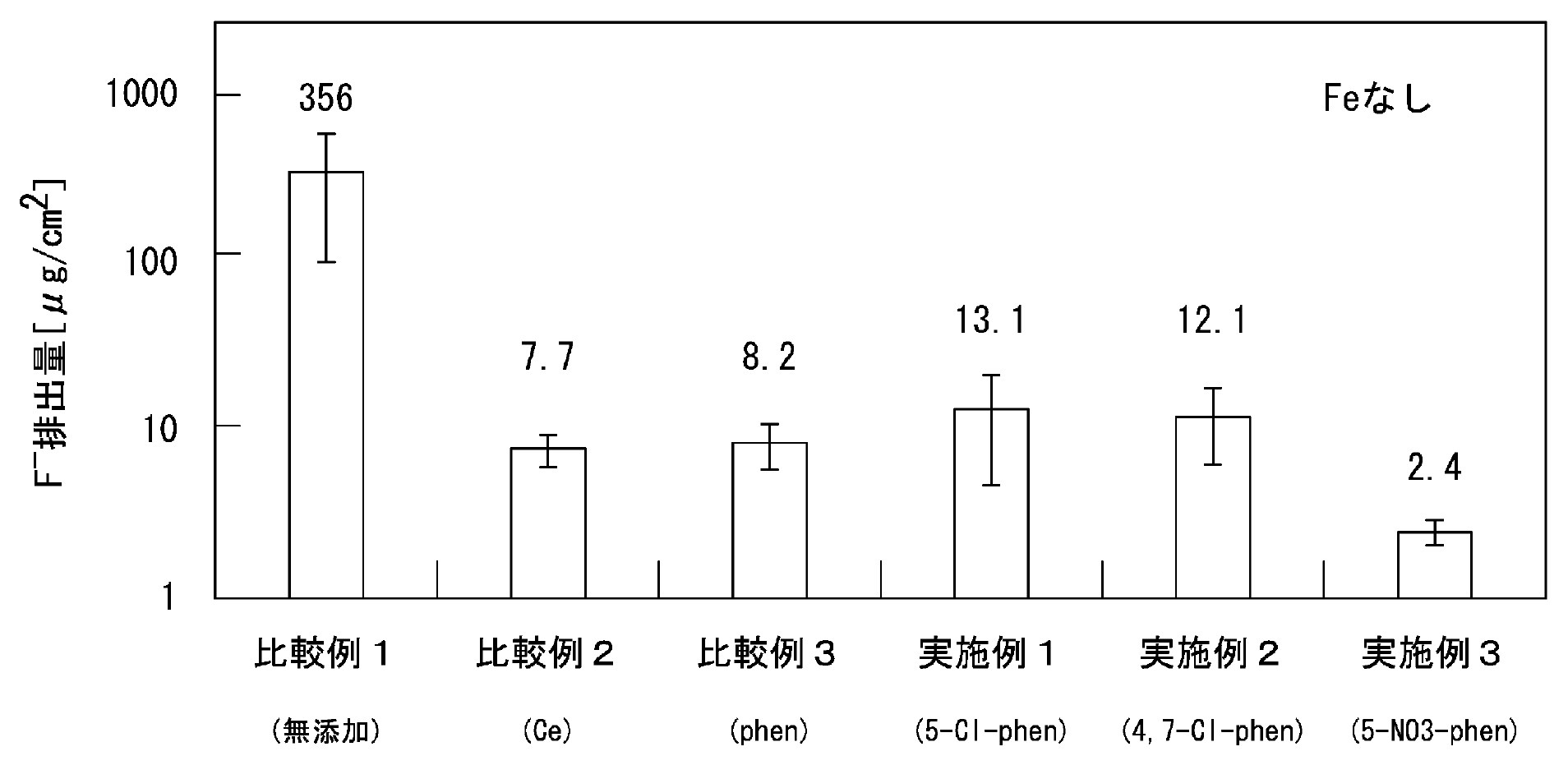
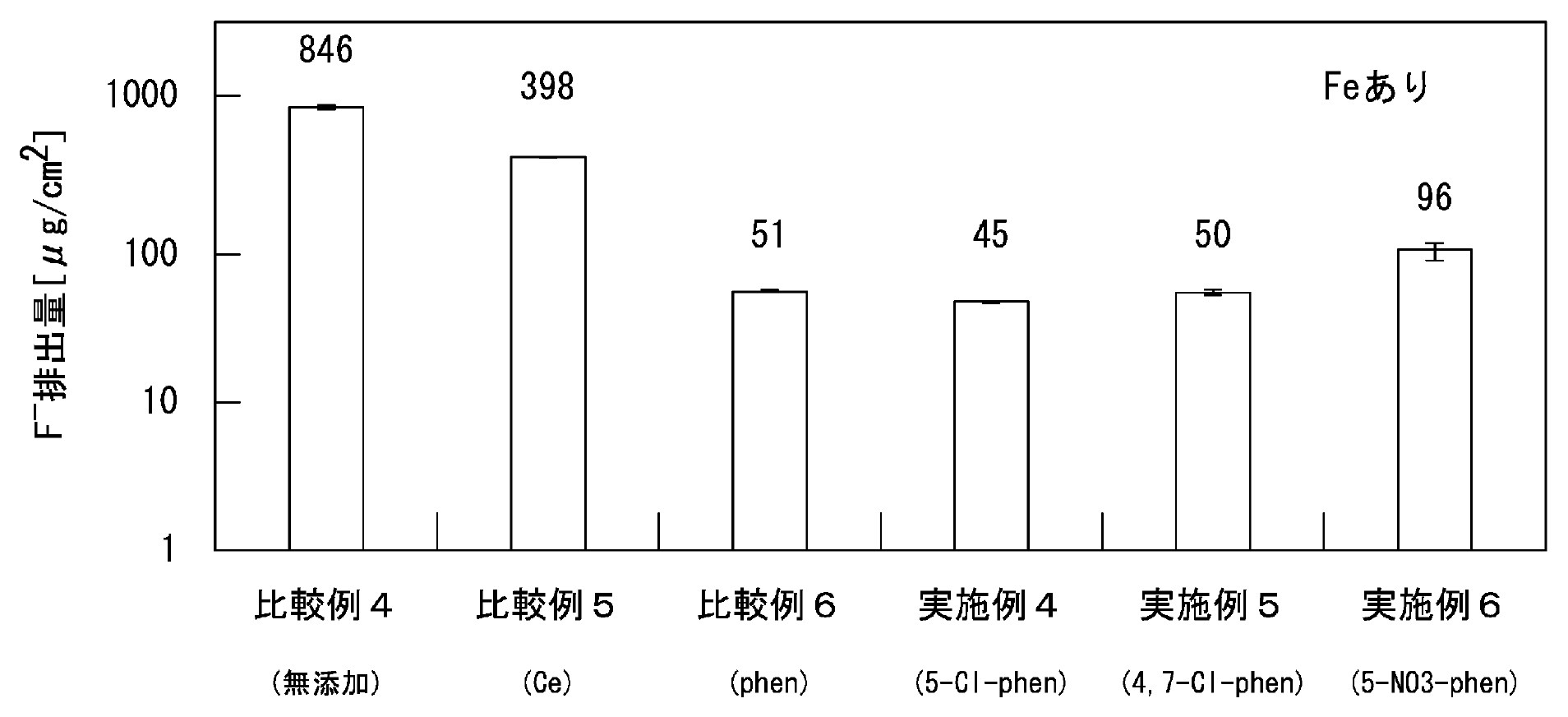
Without added iron, the additive-free cell releases 356 μg/cm2 of fluoride. The 5-nitro complex (Example 3) cuts this to 2.4 μg/cm2, below Ce (7.7) and unsubstituted phenanthroline (8.2), while the chlorinated ligands give 12–13 μg/cm2 (top Figure). With iron added, emission reaches 846 μg/cm2 without additive and 398 μg/cm2 with Ce, whereas all phenanthroline ligands hold 45–96 μg/cm2, the 5-nitro complex highest (bottom Figure). Red membrane color and Fe retained after testing are taken as evidence of complexation, with complex redox potentials of 1.14–1.37 V vs. SHE proposed to enable hydroxyl-radical scavenging. No polarization or water-electrolysis data is disclosed.

比較例 / 実施例: Comparative Example / Example
無添加: no additive
Ce: Ce ions at 4.4 mol% of the sulfonic acid groups
phen / 5-Cl-phen / 4,7-Cl-phen / 5-NO3-phen: 1,10-phenanthroline and its 5-chloro, 4,7-dichloro and 5-nitro derivatives at 1.5 mol% (5-nitro mislabeled "5-NO3" in the source)
Feなし / Feあり: no Fe added (top Figure) / Fe(II) sulfate added (bottom Figure)
Y-axis: cumulative F- emission over the 90 h OCV hold [μg/cm2], log scale

Top Figure: Cumulative fluoride emission over the 90 h OCV hold without added Fe
Bottom Figure: Cumulative fluoride emission over the 90 h OCV hold with Fe(II) sulfate added

TOYOTA CHUO KENKYUSHO KK [JP] / TOYOTA MOTOR CO LTD [JP] / Patent Image
Takeaway: In a PFSA membrane, trace iron can be captured rather than fought: a ligand that binds the contaminant turns a Fenton catalyst into part of the scavenger, without the proton-exchanging cations that cerium leaves behind. Ligand substitution reorders the ranking with iron load, the nitro complex best at contaminant levels and weakest when iron is abundant, and the claimed ligands do not consistently beat unsubstituted phenanthroline. Matching the ligand to the expected iron burden could extend membrane life in the vehicle and stationary fuel cells and electrolyzers the patent targets.

Other Categories (Excel lists are included for paid users)

  • Lithium metal batteries (excluding Li-S, Li-Air): Excel list
  • Lithium-ion batteries – electrolytes – liquid: Excel list
  • Lithium-ion batteries – separators: Excel list
  • Lithium-sulfur batteries: Excel list
  • Na-ion batteries: Excel list