b-science.net
FAQ ☰ Use Cases Blog About Us Register Log In


2026-11-17
Patent Analysis Switch to Visual Summary

Triweekly Patent Update – Free Version

Lithium-ion batteries – electrolytes – all-solid & solid-liquid

FACTORIAL INC [US] / US 20260331497 A1

COATING FOR NEGATIVE ELECTRODE AND SOLID-STATE BATTERIES COMPRISING SAME

Low-cost zinc (Zn) and copper (Cu) nanoparticles in a carbon black coating replace the silver/carbon (Ag/C) interlayer on the negative electrode of lithium metal all-solid-state cells. At a Zn : Cu : carbon weight ratio of 3 : 7 : 90, capacity retention after 20 cycles (0.33C, 45°C) reaches 94%, compared to 74% with Ag/C (25 : 75) and 86% with carbon black alone.

First, lithium-alloying Zn and non-alloying Cu nanoparticles (D50: 40–60 nm, no synthesis route disclosed) and carbon black were mixed with N-methylpyrrolidone containing PVDF binder (7 mass% of the dried coating), with the solvent added slowly under constant stirring. Second, the slurry was bar-coated onto a 10 μm stainless steel foil current collector. Third, the coating was dried in a convection oven (80°C, 20 min) and under vacuum (120°C, 12 h) to 15 ± 2 μm. Full cells paired this electrode (lithium metal negative electrode, lithium metal deposited during first charge) with an argyrodite-type solid electrolyte layer and an NCA positive electrode at 4 MPa stack pressure.

The 3 : 7 : 90 coating delivers 178 mAh/g at 1C, compared to 171 mAh/g for Ag/C, 71.7 mAh/g at a higher metal loading (7.5 : 17.5 : 75), and 122 mAh/g and 118 mAh/g at 0.5 : 9.5 : 90 and 8 : 2 : 90. In half-cell rate tests (counter electrode not specified), charging overpotential is 64 mV at 1C and 334 mV at 5.5C, versus 160 mV and 493 mV for Ag/C.

Takeaway: Replacing silver with zinc and copper raises short-term retention and lowers charging overpotential. Zinc is cited as migrating toward the current collector, while copper, which does not alloy with lithium, stays in place, preserving dispersion and electronic conductivity. The benefit is bounded: too little Zn/Cu in the carbon leaves too little zinc to migrate, too much agglomerates both metals and hinders zinc migration. At current raw material prices (silver ≈1,690, copper ≈13.9, zinc ≈3.7 USD/kg), the metal content per kg of dried coating falls from ≈390 USD to ≈1 USD.

Lithium-ion batteries – negative electrode (excluding Li metal electrodes)

NINGBO SHANSHAN SILICON BASED MATERIALS CO LTD [CN] / CN 123041550 A

A COAL TAR-BASED POROUS CARBON MATERIAL FOR CVD SILICON-CARBON ANODES, ITS PREPARATION METHOD AND APPLICATION

The scaffold for chemical vapor deposition (CVD) of silicon is made from untreated medium/low-temperature coal tar at ≤600 °C, without activating agents or templates. The coal tar was mixed with a LaF3/CeF3 composite catalyst (molar ratio 1 : 1, 0.5 mass% of the tar) and crosslinked under N2 at 200 °C for 2.5 h.

The product was etched in an Ar/O2 (20 : 1 by volume) plasma at 250 W and 350 °C for 25 min. It was then held in supercritical CO2 at 60 °C and 20 MPa for 40 min and depressurized at 0.5 MPa/min, forming oriented straight-through channels.

Before silicon loading, a Si-O-C transition layer was formed on the channel walls by carbothermal bonding with hexamethyldisiloxane (HMDSO) vapor under Ar at 480 °C for 1.2 h, and a silicon-affine Si-C surface layer was grafted onto it in a methyltrichlorosilane (MTS) plasma at 175 W and 90 °C for 18 min. Carbonization under Ar at 580 °C for 1.5 h yields a volume conductivity of 505 S/cm.

The scaffold exhibits a BET surface area of 2480 m2/g and an oriented-channel ratio of 88%. After the active silicon was deposited by CVD from silane gas, with deposition conditions not disclosed, CR2032 coin cells at 0.5 A/g (counter electrode not stated) exhibit a 500-cycle capacity retention of 93% and a lithiation volume expansion of 102%, as compared to 2050 m2/g / 65% / 85% / 118% without rare-earth catalyst, 2350 m2/g / 42% / 86% / 120% without supercritical CO2, 2420 m2/g / 87% / 83% / 125% without HMDSO bonding, and 2200 m2/g / 85% / 88% / 108% for thermal instead of plasma MTS grafting at 350 °C. Silicon content, capacity and first-cycle efficiency are not reported.

Takeaway: Rare-earth-coordinated crosslinking and supercritical CO2 depressurization convert raw coal tar into a channel-oriented scaffold, with the supercritical step governing channel orientation and the HMDSO-derived Si-O-C layer governing cycling stability and expansion. Plasma grafting preserves surface area that thermal MTS grafting partly blocks. Without silicon content or first-cycle efficiency the gain cannot be benchmarked. The route could offer a lower-cost feedstock than phenolic-resin-derived scaffolds.

Lithium-ion batteries – positive electrode

POSCO FUTURE M CO LTD [KR] / KR 20260146167 A

METHOD FOR PREPARING POSITIVE ELECTRODE ACTIVE MATERIAL FOR LITHIUM SECONDARY BATTERY AND LITHIUM SECONDARY BATTERY COMPRISING THE POSITIVE ELECTRODE ACTIVE MATERIAL PREPARED BY USING THE SAME

A spray-pyrolyzed oxide precursor Ni0.62Co0.07Mn0.31Ox (D50: 0.75 μm), which avoids co-precipitation and roasting, was mixed with Li2CO3 (D50: 4.6 μm) at a sub-stoichiometric Li/Me of 0.98 , sintered (930°C, 12 h, CO2-free air) and air-jet milled. The remaining lithium was added during coating as Li2CO3 (6 mol%) with Co(OH)2 (3 mol% Co) at 750°C (6 h), giving Li1.03–1.07Ni0.6Co0.1Mn0.3O2 (Li/Me: 1.066).

The mixture reaches a tap density of 1.498 g/cm3, which the patent links to higher furnace loading, as compared to 1.452–1.463 g/cm3 at Li/Me 0.90 and 1.01–1.07. Before coating, the particles (1–5 primary particles each) show a crystallite size of 239 nm. The patent attributes uneven grain growth from excessive necking between particles to Li/Me above 1.00. Below the range, it explains, grain growth needs more heat, which degrades the surface structure, and the large lithium addition at coating cannot fully react.

In coin half-cells (0.1 C, 2.5–4.45 V vs. Li+/Li, 25°C), the material delivers 201.3 mAh/g discharge capacity at 92% initial efficiency, a DC internal resistance of 22.0 Ω and 0.21 mass% residual lithium, as compared to 198.9 mAh/g, 90%, 25.3 Ω and 0.22 mass% for an over-stoichiometric mixture (Li/Me 1.01), and to 193.9 mAh/g, 89%, 26.3 Ω and 0.72 mass% for a mixture with Li/Me 0.90 (sintered at 970°C, 10 mol% lithium added during coating).

Takeaway: Splitting lithium between sintering a spray-pyrolyzed NMC precursor at sub-stoichiometric Li/Me and a Co coating step raises mixture tap density and gives uniform particles of few grains. Too little lithium at sintering, the patent explains, requires more heat for grain growth, which degrades the surface structure, and a large lithium addition at coating that cannot fully react. Too much promotes excessive necking between particles, giving oversized agglomerates beside fines.

Fuel cells (PEMFC / SOFC / PAFC / AEMFC) – electrochemically active materials

GORE & ASS [US] / WO 2026217395 A1

IMPROVED PROTON EXCHANGE MEMBRANES

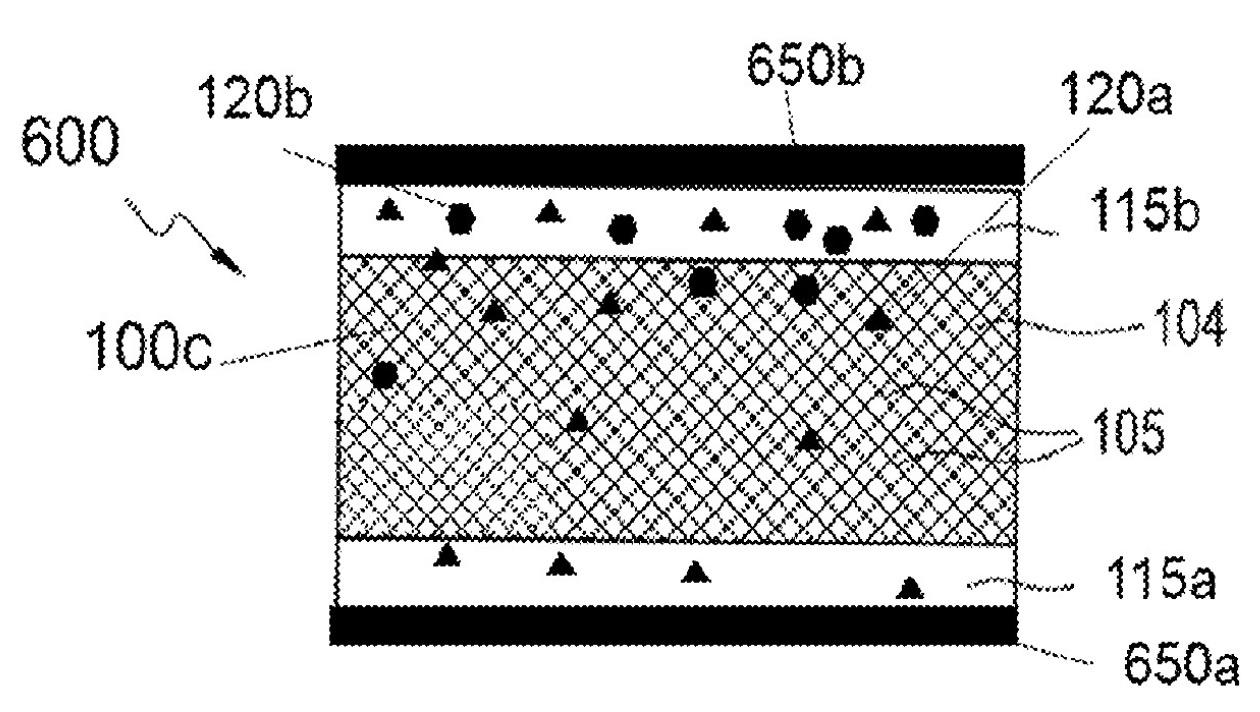
Thinning a PFSA (perfluorosulfonic acid) membrane lowers proton resistance, but below about 15 μm rising hydrogen crossover usually shortens lifetime through peroxide radical attack and pinhole-forming H2/O2 combustion. The reinforced membrane pairs cerium ions spread through its full depth with a Pt/C recombination catalyst confined to the cathode-facing part of the thickness (top Figure).

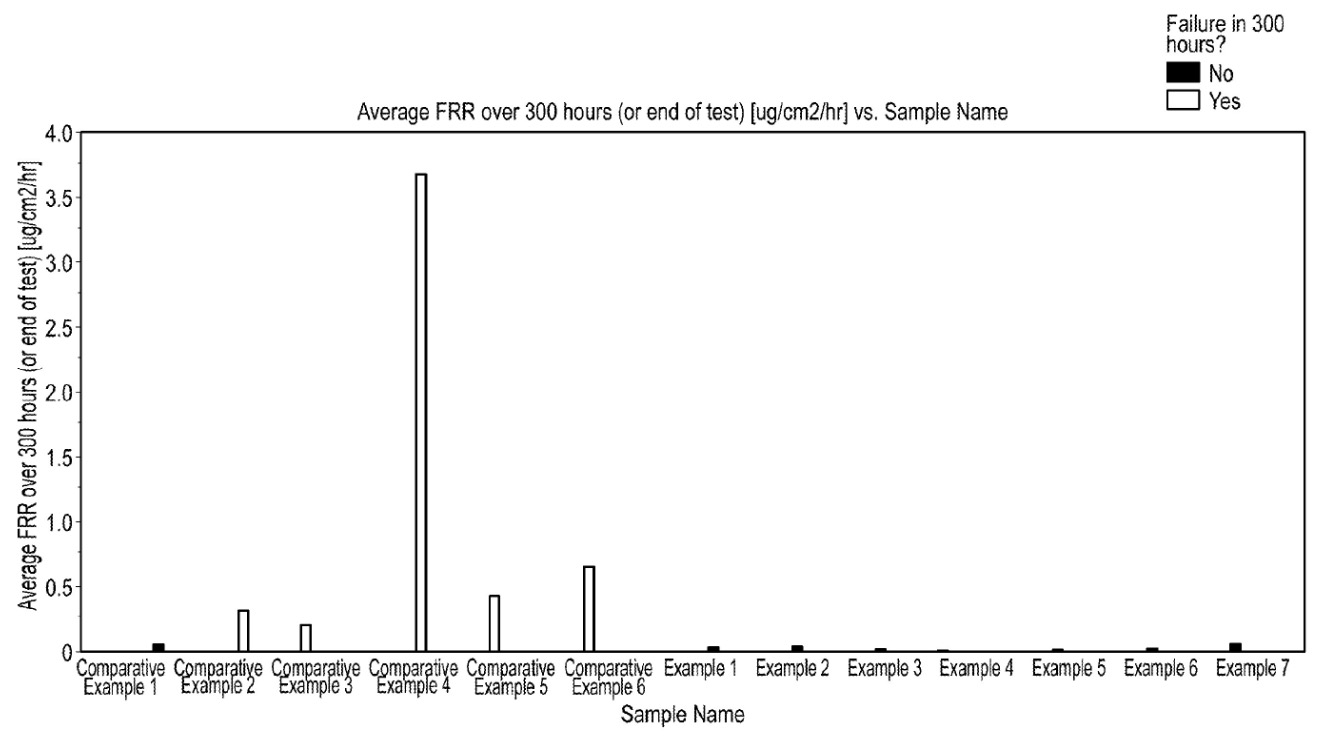
In Example 4, a Ce3+-containing and a Pt/C-containing PFSA dispersion formed two ionomer layers around a 2.2 g/m2 ePTFE (expanded polytetrafluoroethylene) sheet (no coating or drying conditions disclosed). The 6.7 μm membrane (0% RH) holds 6 eq% cerium relative to sulfonic acid groups throughout and 9.74 × 10⁻⁸ mol/cm2 platinum in the cathode-side layer, 31% of the thickness. At open circuit, 95°C and 30% RH, it passes 300 hours without hydrogen crossover reaching the 2 sccm failure limit, releasing 0.006 μg/cm2/h fluoride versus 0.047 μg/cm2/h for a 13.9 μm commercial-type membrane of the same design (Comparative Example 1), at a proton resistance of 52 versus 72 mΩ·cm2 (80°C, 30% RH, method not disclosed). Comparative Examples (CE) 2–6, 8.1–9.8 μm thick, fail within 300 hours at 0.20–3.7 μg/cm2/h when platinum (CE3) or cerium (CE4) is omitted, or platinum is reduced to 6.15 × 10⁻⁸ mol/cm2 (CE2), placed toward the anode (CE5) or spread through both outer layers (CE6) (bottom Figure). No polarization-curve performance data is disclosed.

600: Membrane-electrode assembly
100c: Reinforced proton exchange membrane
650b / 650a: Cathode / anode
115b / 115a: Cathode-side / anode-side PFSA ionomer layer
104: Porous ePTFE reinforcement
105: Reinforcement layer imbibed with ionomer
120a (triangles): Ionic additive, Ce3+ in the examples
120b (hexagons): Recombination catalyst, Pt/C in the examples
Bottom Figure y-axis: Average fluoride release rate over 300 hours or until failure [μg/cm2/h], open-circuit hold at 95°C and 30% RH
Black / white bars: No failure / failure (hydrogen crossover reached 2 sccm within 300 hours)
Example 1–7: Membranes according to the invention, 6.7–9.8 μm thick at 0% RH
Comparative Example 1: 13.9 μm membrane of the same design
Comparative Example 2–6 (CE2–CE6): Reduced platinum, no platinum, no cerium, platinum toward the anode, platinum in both outer layers

Top Figure: Membrane-electrode assembly with cerium ions throughout the reinforced membrane and Pt/C recombination catalyst confined to the cathode-side layer
Bottom Figure: Average fluoride release rate of Examples 1–7 and Comparative Examples 1–6 in the open-circuit hold at 95°C and 30% RH

GORE & ASS [US] / Patent Image
Takeaway: The durability of an ultrathin membrane depends less on how much recombination catalyst it carries than on which face carries it and whether an ionic cerium additive accompanies it. Omitting either the Ce3+ ionic additive or the Pt/C recombination catalyst, or letting platinum reach the anode-facing surface even at higher loading, returns a thin membrane to accelerated ionomer decomposition, seen as fluoride release, and to early hydrogen crossover failure. Controlling that placement could let fuel cells gain the lower resistance of thin membranes without giving up the lifetime of thicker commercial ones.

Other Categories (Excel lists are included for paid users)

  • Lithium metal batteries (excluding Li-S, Li-Air): Excel list
  • Lithium-ion batteries – electrolytes – liquid: Excel list
  • Lithium-ion batteries – separators: Excel list
  • Lithium-sulfur batteries: Excel list
  • Na-ion batteries: Excel list